


When I was a young adult, I’d have regarded as deluded the idea that “the Battle Between Good and Evil” is at the center of the human drama. In the first place, I didn’t have any strong notion of there being forces that could reasonably be called “Good” and “Evil.” And in the second place, the way I saw my world at that time didn’t include any such “Battle” visible at center stage.
But I did have, deep within my being, the visceral feeling that when Evil threatens the world, one is called to fight to defeat it. I’d grown up watching Westerns in which heroes in white hats restore peace and goodness to the frontier by defeating the guys in the black hats. At the end of Shane, it is the down-to-earth good farmers, and not the greedy rancher, who prevail. And I carried in my heart the picture of World War II, into whose wake I was born—where the Nazi Evil was defeated by the nations of the Good, like ours.
I felt strongly that if I were in a situation like High Noon, with the gangster-killers coming into town to turn it back toward lawlessness, I WOULD DEFINITELY BE LIKE GARY COOPER’S MARSHAL, and not like the cowardly townspeople who are ready to accept the triumph of Evil. One cannot let Evil take over the world. And so I took particular pleasure when the marshall’s pacifistic new bride, the beautiful Grace Kelly, actually fires the shot that makes the victory of Good possible.
But my world was not like what Shane’s farmers faced, nor what that Western town faced with the coming of the gangsters to kill the law and take back control.
My world was really overwhelmingly benign. There was no battle between Good and Evil troubling the schools I went to, the suburb I lived in, or the overall institutional situation in postwar America. We knew that we were among the most fortunate people in the history of humankind, and we felt pretty good about ourselves. The world seemed to operate pretty sensibly, except in certain areas where the nation was broken, like the longstanding oppression of black people.
I don’t recall ever worrying that something might happen in America that would cause us to stop making mostly reasonable decisions and start destroying ourselves because we hadn’t been able to keep constructive forces in charge.
In my world, Good had essentially won, and I imagined that was the final score. The debate was less between a constructive option and a destructive one than between competing approaches that were both reasonably sensible. The overall trajectory seemed to be one of continuing improvement.
So when I entered adulthood—say, at the point of my graduating from college in 1967—I did not make decisions based on having an impact on the course of the nation. I could leave that to others, while I pursued something for its inherent meaningfulness.
For me, that meant using the intellect to bring to light the deepest meanings in the human experience of life. I was drawn to the level of symbols and myths and cultural expressions, seeking to illuminate what lies at the heart of the human experience.
When it came time to choose what to write my honors thesis about as a senior at Harvard, I asked myself what I could write about that would be steeped in important meanings. And “Tragic Drama”—tragedy as a dramatic art form—seemed clearly to be one of the deeper rivers. It felt meaningful to explore how tragic drama met certain needs of the people and societies of those places—Ancient Athens and Elizabethan England—where tragedy blossomed.
It was the best way I knew, given my consciousness at that time, to explore the deep meanings of being human. It was imaginatively connected with the religious level, a way of using the intellect that brought me as close as I could then come to a sense of the Sacred.
In a good world like mine seemed to be, I didn’t have to be Shane or Marshal Kane and fight against Evil. I could make a choice like a monk might, going off to a monastery to tend the embers of the Sacred, seeking to keep alive a connection with the Good, the True, and the Beautiful.
But in time, I felt compelled to revise my image of my “good world.” It was as though events had caused a fog to lift, revealing powerful destructive forces at work in the world. The longer I looked, the more I saw that our very survival as a human civilization was in jeopardy because of those forces.
The first step toward that realization came in 1968, a year when upheavals in the larger world converged with upheavals in my personal life.
There was the catastrophe of Vietnam, the violence surrounding the Democratic convention in Chicago, and the Soviet tanks crushing the Prague Spring. Meanwhile, my father’s death had devastated me. And with the arrival of my draft notice, the catastrophe of Vietnam became not just a national tragedy but a threat that reached directly into my own life. All the while, the nuclear sword still hung over our heads in the confrontation between the Cold War superpowers.
Perhaps it was the cumulative impact of all these things. But I was not the same person at the end of 1968 as I had been at the beginning.
It was as though Frank Miller and his gang—the killers coming into town in High Noon—were on the train, heading toward a world I’d thought was safe, threatening to turn it into something much uglier.
And I could no longer imagine simply continuing along the path I’d chosen for my life.
Before, I could envision becoming a professor, doing work I loved and getting paid for it, making contributions akin to those of Joseph Campbell, with his Hero with a Thousand Faces, and Carl Jung, with his interpretation of symbols. I could decipher the underlying human meaning of myths, fairy tales, biblical narratives, and the genres of the arts. I could pursue what seemed most meaningful to me, in harmony with the world around me.
But when I discovered that the world was more out of joint than I’d realized, I felt that my just fitting in would make ME out of joint.
So I pulled the plug on the life I’d been preparing for. If I was going to serve the Good, I needed to understand what had gone so terribly wrong in the human world. I took on a question that seemed essential to any hope of protecting what was good: Why is the world so broken, so full of ugliness and conflict and torment, and so different from the way human beings would want it to be?
What followed were two years of wandering. For the first time in my life, I had no clear goal to strive for.
Except that I felt determined to make sense of the brokenness of the human world. Why was the history of civilization so full of wars, enslavements, exploitation, and countless injustices large and small? Why had human beings created a world so different from what they would have chosen?
Then one day in August of 1970, I found an answer that seemed to me extraordinarily important. It was an insight that I imagined could make some difference in whether Life or Death ultimately wins its battle over humanity’s destiny—whether the human world will be able to get itself together well enough to survive for the long haul on this planet, or whether we will end up destroying ourselves.
It turned out that there IS a battle going on. And that we can discern in that battle actual “coherent forces” that are visibly contending against each other over how much each will be able to shape the world according to its tendency—one whose tendency is to make the world more Whole, and the other to make it more broken. Make it better, or make it worse.
(The crucial discovery was that the source of this destructive force lay not in human nature, but in the circumstances into which humankind had stumbled when it extricated itself from the natural order by taking the fateful step onto the path of civilization. For an explanation of that discovery, see “The Ugliness of Human History is Not Human Nature Writ Large.”)
And it turns out that their interaction can quite reasonably be called the Battle Between Good and Evil.
In 1970, it was the Cold War, and the possibility that humankind might annihilate itself, that made me feel called to become Shane.
I came to believe that the ultimate enemy we needed to fight was not the Soviet Union—though we certainly needed to stand up to Soviet power. The real enemy, of ours and the Soviets, of Arabs and Jews, was the destructive force that had arisen out of the evolution of civilization itself.
And my way of fighting that enemy was to do all I could to help humanity understand the nature of that force: how it had arisen, how it had shaped human civilization in ways that nobody intended or wanted, and how recognizing its workings might help us prevent it from destroying us.
That became my mission.
And for the next quarter century, that mission occupied a central place in my life. The discovery of 1970 became the foundation of my book The Parable of the Tribes, and much of my work in the years that followed was devoted not only to illuminating the destructive forces that had shaped civilization and threatened humanity’s future, but also to awakening people to the nature of the danger we faced, and helping mobilize the will to meet that challenge.
When I later moved to Virginia’s Shenandoah Valley, I recognized my late-60s transformation from monk to warrior in the story of a local hero, Peter Muhlenberg. Muhlenberg was a minister in Woodstock, Virginia, who, in 1776, decided that the struggle for American independence called him to a different kind of service. According to the famous story, he stood before his congregation and declared that there was a time for preaching and a time for fighting. Then he removed his clerical robes to reveal the military uniform he was wearing underneath. The minister had become a soldier in the fight for his country’s future.
When his human world was in a condition he could feel was acceptable – in terms of his understanding of Good and Evil — benign, his vocation was to serve what he understood as the Sacred. Then, when what he valued needed defending, he became a warrior.
It turned out that, soon after the beginning of the new millennium, I was going to have a second Muhlenberg moment.
By the mid-1990s, I had done all that I could to put my breakthrough idea about what I called in my doctoral address of 1977 a solution to “The Riddle of Evil” out into the world. I retired from the battlefield back into a more monk-like vocation of blowing on the embers of the Sacred. I wrote books like THE EXPERIENCE OF MEANING and THE RIVER AND ITS CHANNEL.
I felt free to follow my spirit into whatever domain seemed to promise best to feed my soul—and to speak from my “pulpit” to others in ways intended to blow on the embers in their souls.
Then, in 2004, I had a deepening spiritually transformative experience that took my monkish calling to a whole new level. I felt called, not to fight the Destructive Force that human civilization would have to bring under control if it was to survive, but at last to dwell in the Sacred—in the Wholeness that encompasses the Good, the True, and the Beautiful.
What a relief from always having to deal with the Darkness that besets the human world.
But that numinous promise only made more excruciating the Muhlenberg moment that was soon to follow.
Out of that spiritual experience came an essay, Our Pathways into Deep Meaning, which I also delivered as a talk. And I was happily outlining what I had chosen to be my next book, Mapping the Sacred. I was looking forward to spending my days exploring and celebrating the Wholeness I had been so blessed to experience.
But then, in September 2004, while watching the Republican National Convention, I suddenly SAW something. I cannot explain how it happened, or even how it COULD happen. Because it doesn’t fit into my worldview. But in an instant, a word sprang into my mind—unbidden. EVIL.
What I was seeing, somehow beneath the immediate images, declared itself to my mind as EVIL, something dark and destructive gathering power in my country. Whatever it was—upon reflection, I understood that it had a fascistic character—I sensed in my core that it was threatening to destroy things I held sacred.
And with that perception came the feeling that I was being called once again to battle.
The revelation of 1970 had shown me a destructive force operating throughout the history of civilization, threatening humanity’s future. Now I saw a manifestation of Evil operating within my own country, threatening the future of American democracy.
Once again, I faced the choice between tending the Sacred and fighting the forces that threatened it. But this time the choice was especially agonizing. I had been given what felt like a precious opportunity to dwell in the Good, the True, and the Beautiful. And now I felt compelled to turn away from that gift and immerse myself once more in the Darkness.
It was time to take off the minister’s robes and put on the soldier’s uniform.
So I walked out onto the street with a new website — NoneSoBlind.org — strapped to my leg.
I’ve come to see that the choice between the monastery and the battlefield depends in important ways on the state of the battle between Good and Evil.
When I was young, I felt free to devote myself to exploring the realm of Deep Meanings — the closest thing to the Sacred for me at that time– because I felt no need to defend our most important values.
My becoming a kind of intellectual “monk” was different from the choice that faced the inhabitants of monasteries in the Dark Ages. Their world was ruled by Gangsters — the warlords that had seized power in that era — and the power of that Evil was unassailable. With it being foolhardy to fight what could not be defeated, some who cared about the Good retreated to a place where they could preserve their version of the Sacred so that it would remain alive in the world.
Two reasonable choices in two opposite situations: when I thought that the Good had won, and no battle need be fought, I could be a kind of monk; when it seemed that Evil had won, and no battle could sensibly be fought, others retreated from the fray for their kind of monastic lives and work.
But then there’s the situation where there IS a battle, and the outcome is uncertain. If the Evil is truly threatening, while the Good might yet prevail, that’s when it is the time for all good men to come to the aid of their country, their species, their living planet.
I never imagined until these times that the Spirit of the Gangster would become so powerful in the land of the free, and the home of the brave. But I could no more ride off in a one-horse buggy like Gary Cooper with his bride, leaving the town to the Gangsters, than Marshal Kane could in High Noon. He turned the buggy around and did his Muhlenberg — but he did not do it gladly. Likewise with Shane, when we meet him he does not pack a gun– he’s one of those Cold War Western heroes who’s trying to leave the tools of combat behind him. But ultimately, whatever the cost, these heroes refuse to let Evil rule the world.
The world imposes tragic choices: in a broken world, devotion to the Good can compel a person to enter into the unwelcome Evil of battle.
Better choices will require a better world.
 A Mind-Blowing Collaboration Between a Human and an AI
 My Op/Ed Messages
 Andy Schmookler’s Podcast Interviews
 The American Crisis, and a Secular Understanding of the Battle Between Good and Evil
 None So Blind – Blog 2005-2011 on the rising threat to American Democracy
 How the Market Economy Itself Shapes Our Destiny
 The Sacred Space of Lovers
 The River and Its Channel: Bottom-Up (Flow) and Top-Down (Control) in Fostering the Good
 Ongoing Commentary to Illuminate the American Crisis
 What’s True About Meaning and Value
 Andy’s YouTube Channel
 The Fateful Step
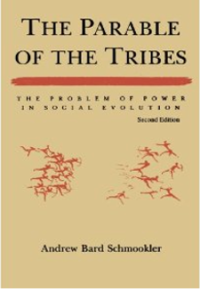 How the Ugliness of Civilized History is not Human Nature Writ Large
 Major Relevant Essays
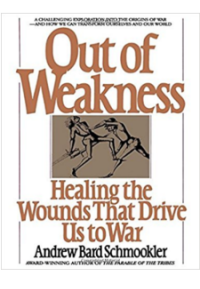 Healing the Wounds, Inflicted by the Reign of Power, that Drive Us to War
 Our Life-Serving Inborn Experiential Tendencies
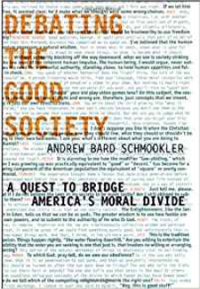 A Quest to Bridge America’s Moral Divide – 1999
 The Heirloom Project
 Knowing What’s Right to do Is Not a No-Brainer