


In many ways, my father’s father (my Zeide) evoked pathos. There was something pathetic, for example, in his impotent rages – against who knows what? – at moments between which he went dutifully about his work, scraping out a living.
Pathetic has negative connotations, but perhaps only from a narrow point of view.
One of the most moving scenes in my childhood occurred when I was perhaps 10 years old, visiting my grandparents – where “family” was in Philadelphia. My brother and I had our two narrow beds strung along the hallway that was most of the second level of the place, with the Mom and Pop shop down below, where my grandparents sold newspapers, sundries, candy, and the occasional ice-cream soda to the residents of their somewhat shabby neighborhood.
I thought the place very romantic, with the trolleys going up and down Girard Avenue, ringing their bells and casting moving lights and shadows on the walls around us.
One night, as my grandfather wound his tired way up the narrow spiral staircase from the little kitchen behind the store, he stopped to talk with us before continuing up to the third floor. (Up there were my grandparents’ bedroom and the place’s one comfortable room, where one could watch TV and the old folks dealt with the day’s proceeds.)
I cannot remember how the conversation began, or how it led to my grandfather telling us this story. (His speech was heavily accented, I assume from having grown up speaking both Yiddish and Russian.)
“I was a boy, like you, back in Russia [it was under the Czar, but in today’s Molodova], and I wanted so much to get an education. But that wasn’t possible where I was, and in my family.” (I think he indicated that his father stood in the way, but I may be painting that into the story because of what came later.)
“But a long way off, there was a school that I might go to. So I ran away to become a student there. But my father caught up with me, and when we got home, he beat me and beat me.”
At this point, he was sobbing, and there were tears coming down his face.
I do not believe that I’d ever seen a grown man cry before. That would have sufficed to make the memory stand out. But what really stands out is the pain and outrage and despair in his voice when he finished by declaring, “I just wanted to get educated!”
He was still outraged that his simple, noble ambition to learn had been punished with a beating.
Looking back now, I see other things about my grandfather differently in the light of that story.
There was Zeide’s bookcase: a whole shelf of books by social thinkers on the Russian scene around the turn of the century—the utopians, the socialists, the anarchists. Names like Sorokin, Bukharin, Kropotkin, Tolstoy.
Although our Zeide did not much engage us in conversation, every once in a while he’d take off on some flight of intellectual imagination, talking about things like social forces, consciousness, and the requirements for justice. One could hear his utopian aspirations in his theorizing. And one could see him grappling to employ well the ideas he’d gleaned from those social thinkers whose books lined his shelves.
But his pronouncements were as muddled as they were impassioned. He sounded like a man trying to put together a barrel without understanding what it takes for something to be able to hold water.
Because of that muddledness, while he had my sympathy, I respected him less than I now think was his due.
Yes, he was muddled. And that meant that he couldn’t meet the standards of my own father – his son — for good, clear thinking.
But now I’m seeing also that his youthful passion for knowledge and understanding survived the beating that dashed his ambitions.
He never ceased striving – however imperfectly — to educate himself, to become a thinker, despite his having had to flee, at the age of 14, a country that wouldn’t educate him (and that persecuted Jews like him). But his life had been about surviving, not succeeding, doing what he could do — as a farmer, salesman, shopkeeper — to raise a family in a foreign land, America. Doing what he could do, without realizing the potential that he once imagined an education would enable him to fulfill.
But it was more than that striving. I’ve come to recognize that my grandfather brought into our family something that is at the heart of what I’ve done with my life: a passion to understand the forces at work in the human world, and to use that understanding to help heal the world.
Understanding that helps move us toward utopia.
(I wouldn’t know how better to sum up what my own life’s work has been about.)
My grandfather, confused as he was, understood that some of the forces at work in the human world are not visible like stones, but more like the wind, visible in how they move things. In that way, he belonged to the universe of thinkers who try to explain what happens in the human world.
That heritage reached me through my own father. But if my father recognized what he’d received from his father, I never heard it.
My father did not respect his own father, I don’t think, though he never said as much. And I can imagine a son might have good reasons for that: impotent rage isn’t what I’d want to see in my father, either.
It was part of the family lore that my grandmother had worked 14-hour days so that my father could go to college (at Temple). And he did indeed get the excellent education that had been denied his father. But I don’t have any reason to suspect that he recognized how much his own intellectual life as a social thinker had been shaped by his father’s passionate but muddled pursuit of the same kinds of questions.
My guess is that my father recoiled from the confusion, focused his own self-development on the need for the clarity and rigor. And he developed a critical mind as good as any I’ve encountered.
(As his son, making some assertion meant being prepared to explore, and being prepared to defend. His critical mind was one hell of a teacher for me growing up. I liked being put through my paces, but trying to meet his standards could also be a strain.)
But in my father’s history, the quest to reach sound conclusions once hit a substantial bump in the road. My brother and I agree that something traumatic happened to him at the end of his college years: for all his clarity and rigor, he discovered that he had made a terrible error in judgment.
(That recognition came when Stalin and Hitler signed their Non-Aggression Pact, which led him to see Stalin in a very different light.)
He was hardly the only one to make that mistake in the 1930s. But Ed and I agree that our father could never trust himself again — in some way that was of some importance to him. Never again would he go public with a position that might be wrong.
He was bold in his career, in that he helped create a new frontier in economics. But he was overcautious in putting his message out into the world: he wrote his book nine times. Everything had to be completely nailed down. No assertions that could be questioned.
(Dad’s work did make an important contribution—and we’ve been told he might have won the Nobel Prize in Economics had he not died before his 49th birthday, but had instead lived a full lifespan—like his friend and colleague Leo Hurwicz, who won the Nobel at 90 and died the following year.)
But that great caution—and likely anxiety—was confined to the public, professional side of his life. It was there that he seems to have felt he must be completely well-defended in his positions.
In private, in the family, I got the benefit of his breadth and depth as a social thinker. It came through in our conversations—like those we’d have driving around the farmland within reach. During our “country drives,” I could ask him about the French civilization and how it differed from the English, or about why something like Nazism could take hold in a country.
He was a thinker, and he thought about the same kinds of things his father did, but did it better, with a richer store of knowledge and much more disciplined ways of thinking.
What I got from my father was of a quality that he could never have gotten from his own father. But it was with my grandfather that the whole enterprise began: the endeavor to find some understanding that might help lead to a better world than the dangerously imperfect one we have now.
 A Mind-Blowing Collaboration Between a Human and an AI
 My Op/Ed Messages
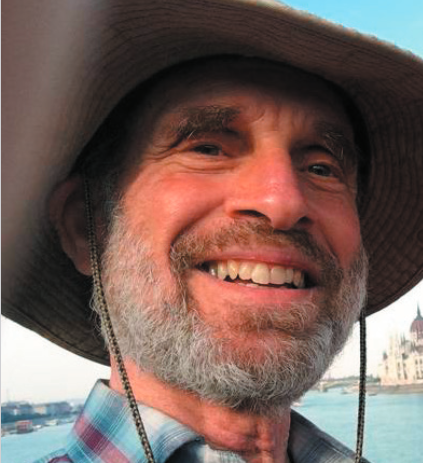 Andy Schmookler’s Podcast Interviews
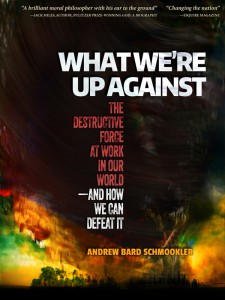 The American Crisis, and a Secular Understanding of the Battle Between Good and Evil
 None So Blind – Blog 2005-2011 on the rising threat to American Democracy
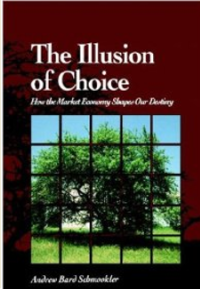 How the Market Economy Itself Shapes Our Destiny
 The Sacred Space of Lovers
 The River and Its Channel: Bottom-Up (Flow) and Top-Down (Control) in Fostering the Good
 Ongoing Commentary to Illuminate the American Crisis
 What’s True About Meaning and Value
 Andy’s YouTube Channel
 The Fateful Step
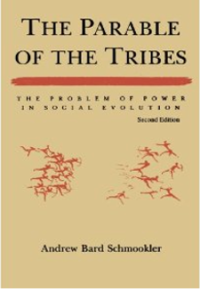 How the Ugliness of Civilized History is not Human Nature Writ Large
 Major Relevant Essays
 Healing the Wounds, Inflicted by the Reign of Power, that Drive Us to War
 Our Life-Serving Inborn Experiential Tendencies
 A Quest to Bridge America’s Moral Divide – 1999
 The Heirloom Project
 Knowing What’s Right to do Is Not a No-Brainer