


A central reality in the Human Story is this: civilization makes demands on human beings that conflict with their inborn nature.
Human beings evolved to live in small, hunter-gatherer groups, in ways continuous with our primate origins. But civilization, shaped by the pressures of an anarchic system of competing societies, imposes requirements that often run against the needs instilled by our long evolutionary history.
Part of human nature is the child’s readiness to absorb from its culture how one should behave and what one should value—in other words, to internalize the demands of its society.
And if those demands are – in important ways — at odds with our inborn needs, as has been the case with civilized societies, the result will inevitably be a kind of intrapsychic war. In that conflict, the internalized voice of society stands in judgment over the needs and desires of the person.
When that internalized voice tells a person that they are bad for wanting what they were born to want, they come to see themselves — and human nature itself — as bad.
The suffering wrought by that intrapsychic war is revealed in a major episode in history: the emergence of Protestantism out of the long domination by the Catholic Church.
Over the centuries the Catholic Church had established a relationship with its flock that required people to subordinate themselves to the authority of the Church. Dogma in belief. Participation in ritual. And a general ethic of obedience that conveyed that one could be acceptable only by submitting to authority.
One was protected from the pain of experiencing oneself as unworthy by the regular confession and absolution of sins.
With the emergence of Protestantism, that protection fell away, uncovering a reality that had been obscured: the painfully negative way people regarded their own nature.
Protestantism declared its independence of the mediating Church structure, for example by making the text of the Bible the new authority, which made individuals their own interpreters. Protestantism brought its followers out from under the authority of that powerful Church and established new forms of religion in which the individual confronted God on their own. And what is telling—in this context of civilization vs. human nature—is how people felt when standing directly before God.: these Europeans, as they confronted God, felt very far from good enough.
One could imagine a creature with human intelligence, capable of conceiving of a Creator and of having a sense of itself, coming before God in the confidence that, as with the loving parent we’d like to have, it will be appreciated for who and what it is. In such a relationship, God might be seen as encouraging growth, but the basic message would be more like Mr. Rogers: God conveys, “I love you just the way you are.”
But when the break from the Catholic Church came, and figures like Luther and Calvin articulated what they experienced when they saw themselves as standing directly before God, what they experienced was very far from that benign sense of being valued and appreciated for who they were.
They felt overwhelmed by their unworthiness: no one deserved salvation; it could come only through the undeserved grace of God.
The depiction of humanity in terms of inherent “depravity” rang true enough to attract a significant following.
And Calvin’s doctrine of predestination, declaring that nothing one could do could affect whether one would be saved or damned, reflected a profound sense of helplessness.
The break from the “shelter” of the Church provides a revealing glimpse into what it feels like to be human in civilization. The highest values we are called to have condemn us as bearers of terrible original sin, and depict us (in the words of the Puritan, Jonathan Edwards) as “Sinners in the Hands of an Angry God.”
-
Postscript:
This low opinion of humankind arises not only from the internalization of civilization’s hostile demands. The same social evolutionary dynamic that makes the demands of civilized societies, in non-trivial ways, hostile to the inborn needs of the human creature also makes the civilized human world uglier than our inherent human nature would otherwise make it.
The anarchy which inevitably will characterize the over-arching system of civilized societies, compelled to interact with each other in the absence of any life-serving order, dictates that only what can prevail in the inevitable “war of all against all” will survive and spread. This inevitable dynamic thus dictates that “the Spirit of the Gangster” will be given a disproportionate say in shaping the world.
With that ugly spirit inevitably prominently displayed in the surrounding world – and with people not recognizing the systemic dynamics that mandated that ugliness – people will take what they see to be human nature writ large.
For more on that inevitable dynamic warping the development of human civilization, see “The Ugliness of Human History is NOT Human Nature Writ Large.”
 A Mind-Blowing Collaboration Between a Human and an AI
 My Op/Ed Messages
 Andy Schmookler’s Podcast Interviews
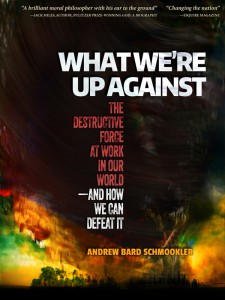 The American Crisis, and a Secular Understanding of the Battle Between Good and Evil
 None So Blind – Blog 2005-2011 on the rising threat to American Democracy
 How the Market Economy Itself Shapes Our Destiny
 The Sacred Space of Lovers
 The River and Its Channel: Bottom-Up (Flow) and Top-Down (Control) in Fostering the Good
 Ongoing Commentary to Illuminate the American Crisis
 What’s True About Meaning and Value
 Andy’s YouTube Channel
 The Fateful Step
 How the Ugliness of Civilized History is not Human Nature Writ Large
 Major Relevant Essays
 Healing the Wounds, Inflicted by the Reign of Power, that Drive Us to War
 Our Life-Serving Inborn Experiential Tendencies
 A Quest to Bridge America’s Moral Divide – 1999
 The Heirloom Project
 Knowing What’s Right to do Is Not a No-Brainer