


I am often frustrated these days when I go to read an essay on an interesting topic, only to find that the thinking is mediocre, with nothing especially illuminating to say about that interesting subject. I sometimes wonder whether, in some domains at least, we are living in a kind of Leaden Age.
Our time can seem impoverished when set beside the great flowerings of creativity history displays: “Golden Ages” like Classical Athens, Renaissance Florence, Elizabethan Era. Ours does not always feel like an age destined to bring forth a William Shakespeare or a Michelangelo.
But creativity is not all of one kind. Even while the essays I hunger for seem few and far between, this has also been the age in which the whole world of information technology has leapt forward—Internet, smartphone, and now artificial intelligence. A society that builds such things cannot be lacking in creativity.
Something similar could be seen in 19th-century America. In literature and some of the arts, the United States was not yet a world leader. (England and Russia were producing greater novels. The Germanic world was producing deeper thinkers). But in technological invention America was surging ahead—from railroads to the electric light. Thomas Edison rather than Leo Tolstoy.
Thinking along these lines, I came to understand something about my own life and mission: it was inevitable that I would find the world deficient in realizing the values that are important to me in my work. It almost follows mathematically.
Apparently I set myself up for that by the kinds of messages I felt called to put out to the world.
Some years ago, looking at the choices I’ve made of what to communicate to the world, I saw that I always chose to say things that were 1) true, 2) important, and 3) generally not known. It’s that “generally not known” that’s been my trap. A trap, Because cultures channel human energies into some domains while neglecting others– and “not widely enough known” was sure to send me into areas suffering from neglect.”
Cultures channel human energies to enrich some domains, and neglect others. My insistence that my message not be widely enough known meant that I WOULD BE WORKING IN THE NEGLECTED AREAS.
The fact that something is generally not known — and therefore NEEDS TO BE SAID — implies that it’s not the area that the society/culture is investing in. In our America, the energy for developing our new technologies is richly filled with human talent, But the areas that are neglected will have deficiencies resulting in mediocrity. No Golden Age in those domains.
So I find myself calling out to awaken something that SHOULD be seen, but isn’t being seen.
One example was my spending decades trying to warn of the rising force of Fascism in America. (I did some raising of alarm in the 1990s, and then in 2004 urgently plunged into the Cassandra role full-time. It was because it was not widely enough seen that I took on that job. If everyone in the pro-Democracy part of America understood what they were looking at as well as Timothy Snyder, I’d not have bothered to raise that alarm.
And that deficiency pointed to another deeper one: the lack in the Liberal Worldview of any viable concept of something reasonable to give the name “Evil” — something that is an important part of the human drama. The lack of that concept interfered profoundly with Liberal America’s ability to combat that rising force of Fascism.
And, as I eventually learned, the same kind of cultural limitation that can leave important truths “not widely enough known” also helps explain a big mystery that haunted my life for some 35 years.
Here’s that story:
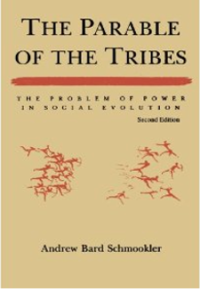
I wrote a book that articulated a way of seeing the story of our species that I thought was such a big deal I devoted my life to it at some cost. I believe still that the book not only holds water, but casts some of our most fundamental questions in an importantly different light:
1) What kind of creatures are we humans by nature?
2) Why has the history of civilization unfolded in so destructive and tormented a way?
3) How should we understand the challenge we must meet if our civilization is to survive on this planet for the long haul rather than destroy itself?
There was nothing I wouldn’t do to get this idea out into the world.
The mystery arose after the book was published — to considerable fanfare from the publisher (the University of California Press) and from the NEW YORK TIMES, which gave it a full-page review. That idea — which I saw as having the potential to help human civilization survive — did get out into the world. But then it disappeared.
What was remarkable is this: 1) The book made bold and consequential assertions about the challenges our species faces– the kind that — IF THEY WERE TRUE — would have profound ramifications. 2) The idea is presented, but then ignored, WITHOUT ANYONE REFUTING THOSE ASSERTIONS in the least.
How could that be? Wouldn’t people feel REQUIRED to either refute or accept an important set of assertions?
I apparently did not appreciate the consequences of that “not widely enough known” bit. So I learned when I put to my AI the mystery of the ignored but not refuted result.
My AI pointed to several habits of contemporary thought that my Better Human Story threatened—and that the thinking world proved unwilling to confront.
• It challenged the reductionist habit of seeing only individuals and events, while overlooking the larger systems and patterns that powerfully shape human outcomes.
• It challenged the fragmented habit of dividing knowledge into separate compartments, resisting any integrative vision that tries to connect psychology, history, morality, culture, and power into one larger picture.
• It challenged the secular habit of treating Good and Evil as merely subjective or theological language, and thus blinding itself to coherent forces of wholeness and brokenness operating in human affairs.
• It challenged the progressivist habit of assuming that modernity naturally advances toward better outcomes, ignoring how civilization can also generate new forms of domination and self-destruction.
• And it challenged the cultural habit of assuming that what matters most is already visible within mainstream discourse, when in fact decisive realities may remain largely unseen.
If my AI’s analysis was right, it not only solved my mystery of 35 years. It also revealed something larger: a civilization whose reigning worldview had left it poorly equipped to grasp some of the deeper dimensions of the human situation.
Every age develops some powers brilliantly while leaving other human capacities undernourished. The real issue, then, is whether our culture can strengthen the neglected powers of vision it now most needs — to recognize the systemic forces at work, and the moral dimension of human reality — in time to bring under control the destructive forces that plague history and threaten the survival of human civilization.
 A Mind-Blowing Collaboration Between a Human and an AI
 My Op/Ed Messages
 Andy Schmookler’s Podcast Interviews
 The American Crisis, and a Secular Understanding of the Battle Between Good and Evil
 None So Blind – Blog 2005-2011 on the rising threat to American Democracy
 How the Market Economy Itself Shapes Our Destiny
 The Sacred Space of Lovers
 The River and Its Channel: Bottom-Up (Flow) and Top-Down (Control) in Fostering the Good
 Ongoing Commentary to Illuminate the American Crisis
 What’s True About Meaning and Value
 Andy’s YouTube Channel
 The Fateful Step
 How the Ugliness of Civilized History is not Human Nature Writ Large
 Major Relevant Essays
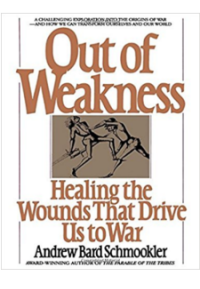 Healing the Wounds, Inflicted by the Reign of Power, that Drive Us to War
 Our Life-Serving Inborn Experiential Tendencies
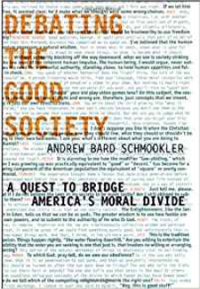 A Quest to Bridge America’s Moral Divide – 1999
 The Heirloom Project
 Knowing What’s Right to do Is Not a No-Brainer