


I have always been hungry for knowledge. As a kid, I was hungry for knowing things like what Ty Cobb’s life-time batting average was (.367), what is the capital of Kansas (Topeka), and especially things like what was the population of New York City in the 1950 census (7,891,957).
And I was like any other kid, I gather, in asking my parents a lot of Why questions. (I was fortunate in having parents who didn’t mind my wanting answers from them. I got rewarded for my constant pursuit of knowledge.)
I wanted to KNOW, and that meant I was driven by my not knowing.
In the years since then, I’ve learned that it wasn’t just my own path that was driven by “not knowing.” The spirit of not-knowing also played a key role in how our Western civilization developed over the last five centuries: not-knowing functioned as a kind of engine of the Scientific Revolution.
The rise of science has demonstrated how great an obstacle to the progress of human knowledge the claim of certainty can be. People who feel sure they already know stop asking questions. People who know they don’t know keep learning more.
Science discovers useful truths, and then maintains enough of the spirit of “not knowing” that it continually subjects its provisional truths to further testing. It is through this ethic of uncertainty that modern civilization has generated bodies of knowledge exponentially deeper and more extensive than in civilizations where dogmatic certainties ruled the world, leaving false “truths” reigning in place.
It is the glory of science that—as its history repeatedly demonstrates—even the greatest ideas do not enjoy the unquestioned status of “and that settles it.” Even the physics of an off-the-charts genius like Isaac Newton didn’t settle things so much that, two centuries later, Albert Einstein couldn’t come along and unsettle our knowledge about the Newtonian universe.
But human beings are not scientists all the time.
A human life requires more than hypotheses and tentative conclusions. To live a meaningful and purposeful life, we need some things that we hold to be true. We need things to believe, and to believe in. We need some things we don’t continually question—things that provide some sort of home, and some sort of compass.
We cannot live well without some sort of convictions.
But, in addition to that need, there’s an added factor that can powerfully move people away from the openness of “not-knowing”: fear. The scarier people find the world, the more they will feel the need for certainty—for uncertainty in times of danger makes the danger more frightening still. And when the stakes are high, the last thing one wants is the added stress of recognizing how much we don’t know, how little we understand—and therefore how little control we have. The greater the danger, the more one will gravitate toward comforting beliefs.
If the sense of danger is chronic, if people’s baseline insecurity is too intense, the need for the comfort of certainty can lead to prematurely closing off questions that deserve to be pursued further.
There’s the old saying, “There are no atheists in foxholes.”
(I’ve never been in a foxhole, but I know that when the stakes are frighteningly high, I feel moved to pray—which I don’t the rest of the time. At such times, I turn toward a belief I need—the belief that there must be something that can make things turn out all right, and that will hear and heed my prayer.)
If science epitomizes the spirit of not-knowing, religion often serves the human need for the kinds of settled beliefs by which a person lives. Religions offer the kinds of truths that provide a foundation for how to live. Essential—but one must be careful how much one ropes into the corral where certainties are kept.
A bumper sticker in the 1990s said, “God said it, I believe it, and that settles it.” For the people who liked that bumper sticker, there seemed to be a whole lot of important issues that were settled. Some of those issues and questions, it seemed clear to me, warranted further thought, being re-examined in a spirit of not-knowing, being open to progress in understanding.
Where religion has often run into trouble is where the certainties of dogma lead to blindness. Like when the Church required Galileo Galilei to stop saying that there were moons circling Jupiter, because the Church “knew” that was impossible. And they would not ask the question enough even to look through Galileo Galilei’s telescope and see for themselves that the astronomy they “knew” was right was not right after all.
It seems we humans need a compass we can rely on to orient us. But we also need the courage to recognize how much we don’t know.
And perhaps the best way to help humankind find the right balance between those two legitimate needs is to build a world in which people feel more secure, and have less to fear.
 A Mind-Blowing Collaboration Between a Human and an AI
 My Op/Ed Messages
 Andy Schmookler’s Podcast Interviews
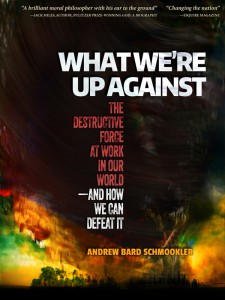 The American Crisis, and a Secular Understanding of the Battle Between Good and Evil
 None So Blind – Blog 2005-2011 on the rising threat to American Democracy
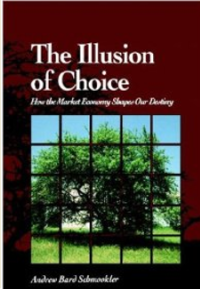 How the Market Economy Itself Shapes Our Destiny
 The Sacred Space of Lovers
 The River and Its Channel: Bottom-Up (Flow) and Top-Down (Control) in Fostering the Good
 Ongoing Commentary to Illuminate the American Crisis
 What’s True About Meaning and Value
 Andy’s YouTube Channel
 The Fateful Step
 How the Ugliness of Civilized History is not Human Nature Writ Large
 Major Relevant Essays
 Healing the Wounds, Inflicted by the Reign of Power, that Drive Us to War
 Our Life-Serving Inborn Experiential Tendencies
 A Quest to Bridge America’s Moral Divide – 1999
 The Heirloom Project
 Knowing What’s Right to do Is Not a No-Brainer