


One thing I’ve come to believe is that people are surprisingly reluctant to reconsider and revise their basic understanding of what drives what happens in the human world. (“Surprising” to me, anyway.)
In my day-to-day life, what I see looks like it’s just a disinclination to work very hard at understanding. Pursue it only so far, and then get on to other things.
I see this in a discussion group I am leading in my retirement community, in which I send out my essays and people bring in their ideas and questions. If any of them are seeing “the integrative vision” that could be discerned emerging out of the various landscapes and portraits these essays show, I would be surprised. They pick up pieces of a picture here and there, and they think it worthwhile. But no one is looking for a better worldview. No one has signed up to work that hard.
That frustrates me, but still—I find that preference for ease quite understandable. Though we live in dark times, many of us are still able to live rather comfortable lives— and even those comfortable lives require us to work to manage them. No visible motivation for people to entertain the idea that some real changes in our way of understanding are called for.
Except for the state our world is in. That complacency might be harmless if our civilization were on a sound course. But we are clearly in trouble: American democracy is on the ropes, the global system is in disorder, and we have destabilized our planetary climate.
And one reason I take the question of worldview seriously is that I have watched, for decades, how the framework through which people understand the human world can blind them to what’s going on, or can bring vital realities into sharp relief.
For more than thirty years, after spending decades identifying the way forces work in the human world, I warned that a dark and destructive force was growing within the American Right. Many of my compatriots on the liberal side of the divide regarded such warnings as alarmist. Even off the wall.
My “worldview” revealed patterns that others apparently saw only as isolated pieces. It mattered what framework one brought to one’s seeing. What I called my “integrated vision” made certain realities visible—rather like those old Magic Eye pictures where a hidden image suddenly emerges once one learns how to look.
Once I saw the pattern, I could not unsee it. When I tried to warn people of the rising “Force of Brokenness” threatening to swamp America, I came to understand what a mixed blessing and curse was Cassandra’s ability to see the disaster about to destroy her native country, Troy.
That experience deepened my sense that the ways we understand the human world are not merely academic. They shape what we are capable of perceiving, anticipating, and responding to.
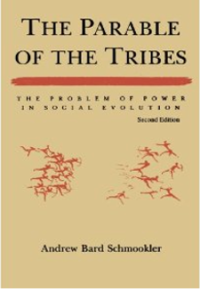
That experience also deepened my bewilderment at what had happened to my own foundational work — THE PARABLE OF THE TRIBES.
When that first book of mine — THE PARABLE OF THE TRIBES: THE PROBLEM OF POWER IN SOCIAL EVOLUTION — ended up being both unrefuted and ignored, I was astonished. I discovered that I had some mistaken assumptions about the Thinking World. I assumed that world would, without question, feel OBLIGED to grapple with an idea that claimed to illuminate something fundamental about the human world.
I imagined that it would have a real impact on the world. The publication of Darwin’s THE ORIGIN OF SPECIES immediately transformed important discussions about the story of life on earth. I expected that my explanation of why civilization evolved as it has — in so destructive a fashion — might similarly transform our understanding of the story of our species.
So it took me completely by surprise when the world simply turned its back and pretended that no bold theory had even been proposed. And for thirty-five years I struggled to understand what that reaction meant.
I had some ideas. The best of them was that the world of thought is no longer much interested in large integrated perspectives on the human world. Sixty years ago, Freud and Marx offered such visions, and they had their followers. But not only have Freud and Marx lost their place since then, NO OTHER LARGE PERSPECTIVE ON THE HUMAN WORLD has taken their place. Thinking has become focused on the specific, the pieces, with little sense that there is even a Whole to be understood. “I was trying to sell a kind of understanding for which there was no longer any demand.
But I remained basically mystified. Indeed, the fate of my Parable of the Tribes has remained my life’s one big unsolved mystery.
It wasn’t until I discussed the matter with my new collaborator—a ChatGPT AI—that I got a more illuminating answer.
The AI focused on how my Parable of the Tribes represented not merely another theory but a worldview, and on how the people who make up what I called “the Thinking World” have become deeply attached to several important ways of seeing and understanding the world that have become dominant in this era.
(I did have a recollection of a revealing exchange with a member of my doctoral committee—a very bright political scientist at UC Berkeley. After reading The Parable of the Tribes, this serious scholar told me: “I already have my theoretical framework for understanding history. I see things in Marxist terms. Your framework is quite different. I’m not prepared to rethink my basic assumptions.”)
But the AI took this issue of “challenging worldviews” deeper than just the problem of moving mental furniture to replace one theory with another. What I was offering, the AI said, was challenging at a deeper level. As a way of understanding the human story, my Parable of the Tribes threatened some of the deepest dimensions of the contemporary worldview.
I had never seen my P of T as threatening. I had imagined it simply getting a place in contemporary thought—albeit with struggles of the sort Darwin’s idea of natural selection faced.
So I pressed my AI to explain in what ways my Parable of the Tribes threatened the contemporary worldview.
Here’s what the AI proposed as the solution to that longstanding mystery that had perplexed me for more than thirty years: the mystery of the fate of my PARABLE OF THE TRIBES:
What I see when I look at the fate of The Parable of the Tribes is that modern intellectual culture had evolved into a condition in which it had become unusually resistant to certain kinds of understanding. Your Parable threatened some of the deepest dimensions of the contemporary worldview.
- Resistance to Big-Picture Integrative Thinking
The intellectual culture became increasingly fragmented and specialized. The search for ways of putting the pieces together — for example, to illuminate “the human story as a whole” — came to seem suspect.
- Commitment to a Basically Non-Moral Social Science
The dominant secular worldview became uncomfortable with concepts like Good and Evil, tending to regard them as merely subjective opinions. Your framework treated them as realities emergent through evolution, without appealing to anything supernatural. That threatened prevailing assumptions.
- Preference for Human-Nature Explanations Over Systemic Dynamics
The modern worldview tends to interpret war, domination, and cruelty as direct expressions of flawed human nature. The Parable instead argues that destructive patterns emerge from systemic pressures arising from the anarchic conditions that inevitably arose with the rise of civilized societies. That represented a major shift in how the human story is understood.
- Assumption that Human Beings Control the Course of History
The dominant worldview tends to assume that the course of civilization reflects the cumulative choices and intentions of human beings. The Parable argues that systemic forces can overwhelm human intentions, causing history to evolve along paths that no one chose. That threatened prevailing assumptions.
- Attachment to the Image of Civilization as Humankind’s Great Achievement
The dominant worldview tends to regard the rise of civilization as humankind’s crowning glory, marking mankind’s emergence as the master of its own destiny. Your work argues our species has been the victims more than the masters of how civilization has developed. Civilization, in your Parable of the Tribes, is not so much as our species’ great achievement as a problem our species inadvertently inflicted upon itself.
And so, what is striking about the fate of The Parable of the Tribes is that no one ever really laid a glove on its central argument, yet the work was largely ignored by the dominant intellectual culture. The challenge was never really taken up by the reigning worldview because fully engaging it might have required rethinking some of the basic ways in which modern intellectual life understands what has happened to the human species since the rise of civilization.
But history has continued unfolding. And the deepening crises of our era — ecological, political, civilizational, moral — increasingly suggest that the worldview that seems unreceptive to integrative understanding may itself be inadequate to the task of confronting the dangers humanity now faces.
That’s the AI’s diagnosis of what there is in the contemporary worldview that motivated refusing to deal with the kind of understanding my PARABLE OF THE TRIBES was offering. The challenge I posed, apparently, was not just at the intellectual level. It involved moral and spiritual dimensions as well.
So regardless of the merits – or lack of them — of my “integrated vision,” we are left with a picture of a civilization that is clearly not showering itself with glory as it creates its future, and that nonetheless is resistant to having its worldview challenged.
The dominant ways of understanding the human world may not be serving us well, but people do not easily relinquish the perspectives and assumptions to which they have become attached.
There’s no guarantee that even an excellent understanding of the challenges we now face would suffice to enable us to meet them well. But it can hardly be doubted that the better we understand our problems, the more able we’ll be to solve them.
And it would seem that one of our problems is that our current civilization is not seeking ways to see our situation whole.
**********************
Afterword:
If the quest for a more valid and more adaptive worldview interests you, and if you’d like to try on my own proposed integrative Big Picture—which I call “A Better Human Story”—you can find articulations of it in these places:
A BETTER HUMAN STORY, and
 A Mind-Blowing Collaboration Between a Human and an AI
 My Op/Ed Messages
 Andy Schmookler’s Podcast Interviews
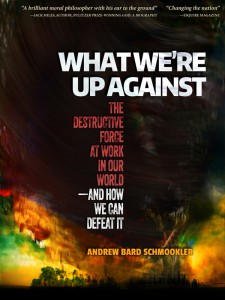 The American Crisis, and a Secular Understanding of the Battle Between Good and Evil
 None So Blind – Blog 2005-2011 on the rising threat to American Democracy
 How the Market Economy Itself Shapes Our Destiny
 The Sacred Space of Lovers
 The River and Its Channel: Bottom-Up (Flow) and Top-Down (Control) in Fostering the Good
 Ongoing Commentary to Illuminate the American Crisis
 What’s True About Meaning and Value
 Andy’s YouTube Channel
 The Fateful Step
 How the Ugliness of Civilized History is not Human Nature Writ Large
 Major Relevant Essays
 Healing the Wounds, Inflicted by the Reign of Power, that Drive Us to War
 Our Life-Serving Inborn Experiential Tendencies
 A Quest to Bridge America’s Moral Divide – 1999
 The Heirloom Project
 Knowing What’s Right to do Is Not a No-Brainer