


[WORKING NOTE: Intended as an introductory/gateway essay to the presentation of A Better Human Story on the General Substack, to be deployed after completion of the AI project. Its purpose is to give readers enough of the foundational Parable of the Tribes argument to motivate them to examine the larger BHS—not to present BHS itself.]
(((((((((((((((((
I want to invite you to consider a way of understanding the human story that I believe is substantially true—and that, if it became widely understood, could improve human civilization’s chances of surviving on this planet for the long haul rather than self-destructing.
I realize that such a claim may seem hard to credit. One might well wonder how any new “story” of human history—however valid—could make any important difference to the human future.
Seeing the human story this way could give us a clearer understanding of why the history of civilization has been so full of war, cruelty, oppression, and other forms of destructiveness. It identifies an inevitability: humanity’s breakthrough into civilization inevitably unleashed a destructive force that people did not choose, but could not avoid.
That inevitability alone has important ramifications:
It should change our opinion of ourselves as a species. If much of the ugliness we see in human history was driven by forces that arose inevitably from the structure of civilization, then that ugliness does not reveal the true face of our species. We are better creatures – capable of inhabiting a better civilization — than our history has made us appear. And knowing this will fortify us for the historic struggles that we are currently engaged in.
And if we are still caught up in that same destructive force that inevitably arose with civilization, understanding that force—how it arose, how it operates, and how it has shaped the human world—can help us see more clearly what must be changed if we are to create a more humane and viable civilization.
The central argument rests on a logic that seems to me so compelling that the question becomes less, “Did this really drive how civilization developed?” and more, “How could humankind possibly have escaped from this inevitable social evolutionary force?”
Indeed, how could any civilization-creating creature on any planet have escaped that force once it extricated itself from the niche in which it had evolved biologically by inventing its own new way of supporting its life?
More than ten thousand years ago, our ancestors made a breakthrough unprecedented in the four-billion-year history of life on Earth—becoming the first to use their creative intelligence to invent a new way of life. For millions of years, our ancestors had lived, as their primate ancestors had before them, within a biologically evolved niche in the natural order, supporting their lives with what nature spontaneously provided. Then our species began to break out of that ancient arrangement through creative innovation.
That was a major point of discontinuity in the history of life. Everything since the beginnings of horticulture and herding (replacements for gathering and hunting)—leading over thousands of years to agriculture—should be understood as part of that unprecedented new path: the path of civilization.
But that path led inevitably into a trap.
For billions of years, natural selection had created an elaborate natural order, selecting not only the characteristics of individual creatures but patterns of relationship among them that enabled the whole system of life to keep going. The lion and the zebra and the grass work together to create a virtual perpetual-motion machine, even as they devour each other.
Humanity’s breakthrough into civilization broke outside that natural order. The new civilized societies emerged as actors in a system of interaction that was outside the natural order and beyond the reach of any human-created order.
For the first time in the history of life, therefore, powerful living entities were interacting in a system in which there was no order governing their relationships.
The result was something unprecedented: systemic anarchy.
And systemic anarchy inevitably creates a problem of power. In a system with no order governing the relationships among societies, nothing prevents one society from using whatever power it acquires against another. And there is nothing that guarantees the security of the others except their own power.
Anarchy thus creates a “war of all against all.” And in such a system, the societies that survive are necessarily those capable of prevailing in that struggle. “Power,” as I use the term here, means whatever enables a society to prevail in that war of all against all.
Suppose one society becomes more powerful than its neighbors and uses that power to conquer them. Those neighbors face a choice they never asked to make: increase their own power or be eliminated. As the process continues, societies that are less able or willing to play the power game are disproportionately conquered, destroyed, or compelled to imitate the ways of those that prevail.
A process of selection has arisen—selection for the ways of power. And that selection arises not from human nature, but from the inevitable anarchy of the overarching system into which these unprecedented new forms of life—humanly invented societies—have inevitably emerged.
Of all the different ways human beings might invent for organizing civilized life, those that could not survive the war of all against all would be eliminated, no matter how admirable they might be according to other human values. What survived and spread would be disproportionately the ways that enabled societies to prevail in the struggle for power.
Here, then, was the great and tragic irony of humanity’s breakthrough into civilization. Our creative intelligence appeared to have liberated us to choose our own way of life. But the systemic anarchy that inevitably accompanied that breakthrough subjected those choices to a new process of selection. The course of social evolution would therefore be determined not simply by what human beings chose, but by what could survive in the struggle for power.
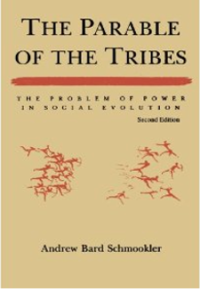
The central argument I have just sketched has been before the world for more than forty years. I first presented it in The Parable of the Tribes, published by the University of California Press.
Its arrival was well announced. The book was widely reviewed, including in a full-page review in The New York Times. The following year, Esquire published a feature about me as the author of the book and the idea it presented. For several years, The Parable of the Tribes made something of a splash.
But being noticed is not the same as receiving a serious intellectual hearing. No one showed any holes in what I regarded as the compelling logic of the argument. No one showed that the idea was not true to the evidence.
The argument was neither refuted nor accepted. Nor did the thinking world wrestle with the idea to decide whether it should be rejected as invalid or adopted as an apparently more valid way of understanding the human story.
Then, after half a dozen years, it simply disappeared from the intellectual conversation. As if a major proposed revision of our view of what had happened to our species over the past 10,000 years had never been proposed. Just ignored, despite the major ramifications of the idea if its argument were valid.
The fact that an argument has not been refuted certainly does not establish that it is true. But here we are, decades later, and no verdict was ever rendered because, for whatever reason, the trial was never held.
So I would like to invite you to examine the case and render your own verdict.*
Don’t take my word for it. Examine the argument. Look for holes in its logic. Ask whether it fits the evidence of human history. Ask whether there is some way our species could have escaped the social evolutionary process I have described. Consider the implications—for our understanding of ourselves, for our understanding of our past, and for the challenges we must face if we are to have a viable future—if the breakthrough to civilization really did have such inevitable consequences.
And then decide for yourself: Is an intellectually responsible person required to adopt this way of understanding the human story as substantially valid?
+++++++++++++
* A person might reasonably dismiss the possibility that an extraordinary claim is true without even looking, if the person making the claim seems utterly implausible as the source of such an achievement. But then there are those who might conceivably have done such a thing, if anyone could.
A biography cannot prove such a claim valid, but it can establish that someone is a Maybe. My biography [LINK] should preclude dismissing my claim without hearing the case—starting with my having graduated summa cum laude from Harvard for work similar in kind to the more ambitious A Better Human Story: interdisciplinary theoretical explanations of socio-historical phenomena.
 A Mind-Blowing Collaboration Between a Human and an AI
 My Op/Ed Messages
 Andy Schmookler’s Podcast Interviews
 The American Crisis, and a Secular Understanding of the Battle Between Good and Evil
 None So Blind – Blog 2005-2011 on the rising threat to American Democracy
 How the Market Economy Itself Shapes Our Destiny
 The Sacred Space of Lovers
 The River and Its Channel: Bottom-Up (Flow) and Top-Down (Control) in Fostering the Good
 Ongoing Commentary to Illuminate the American Crisis
 What’s True About Meaning and Value
 Andy’s YouTube Channel
 The Fateful Step
 How the Ugliness of Civilized History is not Human Nature Writ Large
 Major Relevant Essays
 Healing the Wounds, Inflicted by the Reign of Power, that Drive Us to War
 Our Life-Serving Inborn Experiential Tendencies
 A Quest to Bridge America’s Moral Divide – 1999
 The Heirloom Project
 Knowing What’s Right to do Is Not a No-Brainer