


I’ve lately been thinking that I have missed something about how people have become broken by the destructive force that inevitably got unleashed when humans took the unprecedented step of breaking out of the niche in which we had evolved biologically.
Here’s the path that has led me to thinking that I’ve neglected the problem of how the quality of mothering may have contributed to the larger picture of Brokenness in the civilized human world.
The path begins with the emergence of a new kind of disorder. The rise of civilization began with clusters of separate societies compelled to interact in the absence of any order that had evolved to make the system viable. With no power above them to keep the peace. ANARCHY inevitably characterized the system of these “sovereign” societies. And this anarchy led inevitably to a war of all against all.
Such an embattled war inevitably entails people enduring trauma. And trauma — experience that can’t be integrated into the psyche — is a form of Brokenness.
That war of all against all inevitably generated brokenness in a second way.
Inevitably, only some societies will survive in such a conflictual world, and it will not be random which societies can so prevail. The anarchy thus also inevitably generates a selective process that mandates that only those societies that meet the demands of competitive power will survive and spread. While other societies will be eliminated — destroyed or absorbed.
With societies therefore SHAPED BY THE DEMANDS OF POWER, another form of brokenness is also inevitable. People brought up in such societies are required to internalize their society’s demands, which can be in important ways at odds with the needs of human nature. That means that the rise of civilization also generated the brokenness of intra-psychic warfare: conflict between inborn human needs and power-determined cultural requirements. For years, that was where my account of the sources of human brokenness stopped: trauma and internal warfare.
But there was something else the ways of power did to the human world. For thousands of years, because of what I call “The Problem of Power in Social Evolution,” civilized societies have been permeated by men’s domination and mistreatment of women. And it is inevitable that the mothering done my women thus injured by abuse will not be identical with the mothering done by women treated better. And there is reason to believe that before civilization, women were treated better.
I had somehow imagined that the mother-infant relationship was so deeply rooted in nature that I wasn’t looking for civilization to have corrupted it.
After all, maternal care is hardly something human beings invented. I’ve watched mother cats caring for their kittens, and there is something quite beautiful about seeing those powerful instincts at work. The bond between mother and offspring seems to come from somewhere very deep in the biological inheritance.”
(Indeed, there is some evidence that the conditions in which our hunting-and-gathering ancestors raised infants were especially well suited to meeting infants’ evolved needs.)
But here, as elsewhere, the transformations wrought by civilization have given our biological evolved nature problems to contend with.
The powerful maternal instincts that evolution built into us have had to operate within whatever circumstances civilization created for mothers. And for thousands of years, those circumstances have included the domination and mistreatment of women.
Research confirms what common sense might lead us to expect: a mother who is depressed, severely stressed, abused, or living in fear may be less able to give her baby the warmth, responsiveness, and loving attention through which the baby first discovers what it is like to be cared for by another human being.
So I had more or less assumed that human babies would generally get what they needed from their mothers. Certainly there would be terrible exceptions. But I had not imagined that failures in this most fundamental of human relationships might be widespread enough to constitute an important source of the brokenness people grow up to bring into the human world.
Apparently they are.
The evidence from studies of attachment suggests that something like two-thirds of infants develop what psychologists call a “secure attachment,” while roughly a third do not. The numbers vary from study to study and from population to population. But behind that clinical term lies something elemental: the baby’s experience of being loved and welcomed into the world, of having its needs matter, of finding comfort in another human being, and of learning that closeness is a source of nourishment rather than danger. A very substantial minority of babies do not acquire that foundation as fully as they need.
What is missing here matters not only to the baby, but to the person that baby will become. A child who begins life with that foundation has something to build on: a deep experience of being loved, of trusting another human being, of feeling that life can be good. A child who does not get enough of that experience enters the rest of development without as much of that inner ground beneath him.
What is lost is likely to be a non-trivial part of the person’s capacity for happiness. (And, as I’ve argued elsewhere, any meaningful concept of the Good must be founded on THE POSITIVE EXPERIENCE OF SENTIENT BEINGS like us humans.)
Someone who has not sufficiently experienced the nourishment of loving relationship at the beginning of life will likely be less able to find that nourishment in relationships later on. Something that should have become a deep source of well-being throughout life has been impaired at its foundation.
If that were the only way that inadequate mothering contributed to Brokenness in the world, that would still be plenty. If civilization’s problem with power has interfered with the capacity of a substantial portion of human beings to experience one of life’s greatest sources of fulfillment, that belongs in any accounting of the damage civilization has done to the Good in the human world.
But I suspect the destructive consequences may go beyond that.
One possibility is that this early foundation affects how well a person can deal with the other major psychological source of Brokenness I described earlier: the internal warfare created when the demands of a power-shaped culture conflict with the needs of inborn human nature.
A person who has acquired a deep underlying sense of being loved, of being worthy of love, and of finding nourishment in relationship may have more of the inner strength needed to come to acceptable terms with the potentially painful conflict between what he is and what his society requires him to be. Without that foundation, that conflict may be beyond the person’s capacity to find inner peace.
And that matters enormously. For the failure to achieve such reconciliation has been perhaps the major psychological ally of Evil in the civilized world. (See When “Good” People Support Evil Leaders – A Better Human Story.)
What people cannot accept in themselves does not simply disappear. Forbidden impulses may be driven underground, projected onto others, or find disguised ways of governing the behavior of people who “know not what they do.”
The warfare within the person thereby becomes a means by which Brokenness gets translated into Evil in the world. So in this way, the lack of a happy foundation in the growing infant may contribute to the destructive work of that Force of Brokenness that civilization has loosed upon the world.
 A Mind-Blowing Collaboration Between a Human and an AI
 My Op/Ed Messages
 Andy Schmookler’s Podcast Interviews
 The American Crisis, and a Secular Understanding of the Battle Between Good and Evil
 None So Blind – Blog 2005-2011 on the rising threat to American Democracy
 How the Market Economy Itself Shapes Our Destiny
 The Sacred Space of Lovers
 The River and Its Channel: Bottom-Up (Flow) and Top-Down (Control) in Fostering the Good
 Ongoing Commentary to Illuminate the American Crisis
 What’s True About Meaning and Value
 Andy’s YouTube Channel
 The Fateful Step
 How the Ugliness of Civilized History is not Human Nature Writ Large
 Major Relevant Essays
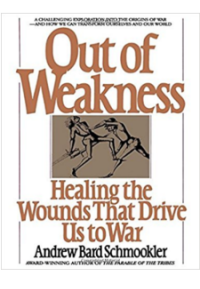 Healing the Wounds, Inflicted by the Reign of Power, that Drive Us to War
 Our Life-Serving Inborn Experiential Tendencies
 A Quest to Bridge America’s Moral Divide – 1999
 The Heirloom Project
 Knowing What’s Right to do Is Not a No-Brainer