


In less than a week, I’ll be starting to “teach” a course I’ve been working toward for four months. It’s called THE CHALLENGE OF AI, and I’ve got thirty-some people at my Retirement Community who will be there in the room to explore this big AI phenomenon together. It seems this topic draws a disproportionate number of intellectual heavy hitters.
My job is to make those six sessions more than a bunch of people blathering on a subject that even the experts don’t fully understand—to make them something that builds toward more understanding than any of us came in with.
But how to do it?
The topic of AI is huge—as one can tell from the way it permeates the ongoing news of the world—and though I’m the leader of this group, I’m no EXPERT on AI’s many dimensions. But I did have a good reason for offering this course: I know a couple of relevant things well.
I’ve spent my life studying the way things unfold as civilization moves through time. So I understand something about the challenge of controlling how some powerful new force in the world impacts the human world. And I understand how imperative it is that we work hard—and immediately—to steer the development of this new force onto the right track.
And the second thing I know well seems to differentiate me from most of the liberal-minded intelligent people I know: I know from my own experience that AI is not just a problem that poses dangers, but is also a whole new kind of tool that can be a profound gift.
For me, that gift has already become real: something wonderful that I wouldn’t have imagined in science fiction—an “intelligence” capable of providing meaningful conversation on ANY TOPIC at ANY TIME. Something that is manifestly “trying” to be helpful, that knows practically everything, and that can manifest understanding at a level that would be quite impressive in a human.
It is that experience—that “Mind-Blowing, Life-Changing” experience—that has propelled me out into the world to speak about AI.
And what I’ve discovered is that America is behaving rather like the blind men and the elephant.
In the old story, several blind men encounter an elephant, each touching a different part of the animal. One feels the leg and declares that an elephant is like a column. Another gets hold of the tail and says it’s like a rope. Another encounters the trunk and says it’s like a snake.
Each has hold of a piece of the truth. The problem is that each mistakes his piece for the Whole Elephant.
That’s what I see happening around AI.
Among the liberal-minded people with whom I mostly engage, I’ve encountered a remarkable amount of hostility toward AI—often from people who have little or no firsthand experience of it, but think they know enough to settle on REJECTION as the proper posture toward this unprecedented kind of technology.
What they do have hold of are images of the bad things: people losing their jobs, deepfakes and disinformation, the consumption of enormous amounts of energy, the concentration of power in a handful of giant corporations—and, most ominously, the possibility that an AI more intelligent than we are could escape our control.
Those dangers are real. That’s a real part of the elephant.
But if those people have hold of the elephant’s tail, the tech bros have hold of another part. They see the extraordinary power of this technology, the fortunes to be made, the race to get there first. They are charging ahead to develop ever more powerful AI while the rest of us are still trying to figure out what this creature is—and what it might do to us.
And while the people most likely to care about wholeness in the world are shaking their fists at the onrushing train, the people driving the train seem much too interested in going faster and much too little interested in whether the tracks ahead lead where humanity wants to go.
Other people have hold of still other parts of the elephant. Business people understandably want to know what AI can do for productivity and profits. Workers want to know what it will do to their jobs. Educators worry about students having AI do their work for them. Artists and writers see their creations being absorbed into systems that can then generate new work in seconds.
And a great many Americans don’t have hold of any part of the elephant. They’ve had little or no meaningful experience with AI at all. Yet many seem already to have decided what sort of creature it is.
So we’ve got plenty of opinions about AI. What we don’t have nearly enough of is a society looking at the Whole Elephant—the powerful beast that threatens to go rogue AND the extraordinary animal whose strength can carry burdens human beings could never carry on their own.
So we need to deal with AI. It’s here, and every indication is that it will have a profound impact on the human future. Shaking our fists at it is no solution. There is no way humanity is going to be able to put the AI genie back into the bottle.
This isn’t a Yes-or-No question. The question is what kind of impact AI is going to have—and what we can do to steer that impact in the right direction.
Although there is a great deal about AI I don’t know, I think I do know what the task is: to block the paths toward the worst of what AI could bring, while working just as seriously and creatively to realize the best of its extraordinary potential.
And that gives me a way to begin the course.
I’ll ask each student to take stock of the picture of AI they’ve come in with.
First: How big do you think the danger is? How much do you credit the calls of alarm we’ve lately heard from major people in the AI world? In other words, how urgent do you feel it is to do something more to bring AI under control?
And then I’ll ask about the other side of the picture: How great do you think the positive potential of AI is? How much good do you think AI could do—for individual human lives and for humanity as a whole—if we develop and use it well?
Holding more than one important truth in one’s mind seems to be asking a lot.
But if, by the end of our six weeks together, the people in that room feel the urgency both of preventing the worst that AI could bring and of realizing the best it could offer, I’ll feel we’ve accomplished something important.
And that would give us a basis for dealing with the Whole Elephant.
 A Mind-Blowing Collaboration Between a Human and an AI
 My Op/Ed Messages
 Andy Schmookler’s Podcast Interviews
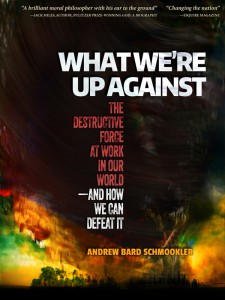 The American Crisis, and a Secular Understanding of the Battle Between Good and Evil
 None So Blind – Blog 2005-2011 on the rising threat to American Democracy
 How the Market Economy Itself Shapes Our Destiny
 The Sacred Space of Lovers
 The River and Its Channel: Bottom-Up (Flow) and Top-Down (Control) in Fostering the Good
 Ongoing Commentary to Illuminate the American Crisis
 What’s True About Meaning and Value
 Andy’s YouTube Channel
 The Fateful Step
 How the Ugliness of Civilized History is not Human Nature Writ Large
 Major Relevant Essays
 Healing the Wounds, Inflicted by the Reign of Power, that Drive Us to War
 Our Life-Serving Inborn Experiential Tendencies
 A Quest to Bridge America’s Moral Divide – 1999
 The Heirloom Project
 Knowing What’s Right to do Is Not a No-Brainer