


MORTALITY RUNS IN MY FAMILY
It’s safe to say that I am not the only one who finds it challenging to come to terms with death. Indeed, our awareness that we are going to die has been described as one of the defining characteristics of being human. Ernest Becker, in his book The Denial of Death, went so far as to argue that humanity’s difficulty in facing the inevitability of death has been a major driving force in the development of human civilization.
As a boy of 6 or 7, my thoughts about death sought to escape that inevitability. By the time I’d reached the age when the human lifespan had perennially come to an end, I thought, the kind of people who’d split the atom would have found a way to stop that clock from counting down.
Or, if humanity hadn’t achieved that kind of breakthrough, then maybe it would turn out that I was special, and had escaped the logic of that famous prototypical syllogism: All men are mortal; Socrates is a man; therefore Socrates is mortal. Maybe Andy Schmookler would be a man who wasn’t mortal.
Life for a long while spared me any intimate familiarity with death — human death anyway. A sweet cat of ours had been killed by a car when I was nine, and I grieved for her. But nobody in my circle of “family” had died. My mother’s parents were dead when I was born, while my father’s were still alive. And no uncles or aunts had died. I had never attended a funeral until I was 21. But that one was a big one.
The funeral was for my father. And such was my closeness to him that I was devastated by grief that went deeper than any I’d had before or since. He’d had a terminal disease (Hodgkins) that I’d known about for more than four years, but I’d never stopped hoping that some medical breakthrough would rescue him. That rescue never happened.
Dad’s death was not only a loss of someone I loved, but a loss also of some innocence about my own mortality. I’d always identified strongly with him, so what could happen to him could happen to me. And strictly in terms of genetics, that old boyhood fantasy about being made of immortal stuff became even more ridiculous.
There was also something powerful and frightening about the Face of Death that I saw in my father’s final hours. It would have been devastating enough if Dad had gone gently into that “good night”: but “he passed away peacefully in his sleep” was not the picture I was left with. When I made it from the airport to his hospital room near the end — the doctor later said they thought he’d waited for me — the sound of his raucous and labored breathing in the coma into which he’d lapsed was terrifying to me.
My first real encounter with death was profoundly frightening. The image of Dad’s body going through its final departure from life was one that haunted me for a long time.
HOW CAN IT BE?
My boyhood attempts to come to terms with death weren’t entirely about my own desire to escape it. There was something about the very idea of Death that boggled my mind.
I remember driving with my father on a Minnesota highway in the darkness of a summer night. Every so often, a moth would suddenly flare into view in the headlights and go smoosh against the windshield. One moment a living creature, the next just a smear of gunk on the glass.
It seemed to me that something momentous had happened. A living being had ceased to exist. Yet we simply drove on through the darkness.
AS TIME GOES BY
It is not just my own mortality that is bringing me to think more about death as time goes by– as you might expect would be the case for an 80-year-old man. In fact, it doesn’t seem to be MOSTLY about my own mortality. As for me, my decline has not been so great as to compel me to contemplate “the end of the line.” But with the passage of time, the list of my lifelong friends have been “thinning out.” If I’m 50 years older than I was at 30, so also are all the people who have been part of my human circle all those years. And I’ve been noticing how the list of friends who have died has been getting a lot longer.
At the same time, there is the fact that April (still healthy, thank whatever) and I have moved to this “vibrant” retirement community, where the average age is 85 or 86 years old.
With a population of 2400 people, mostly a good deal beyond the biblical “three score and ten,” it is inevitable that death will be a frequent occurrence. A good deal more frequent than in a random town of the same size, with people of all ages. And indeed, we get announcements of the ‘We regret to report the passing’ variety many times every month. In my year and a half here, only a few have been people whose lives touched mine in any way I could remember. But still, ….
But death isn’t the whole thing. It isn’t even the main thing. The main thing is that one can see so vividly that each human life is programmed not only to die but to deteriorate along the way, according to a more-or-less predetermined timetable.
We are born with a life-span, and while we might affect it at the margins, the inescapable lot of every human life is not only to die but to lose our organic wholeness along the way. The one-time athlete who can no longer walk. The once smooth skin that now grows unsightly barnacles. The classes on how to avoid losing one’s balance and suffering a crippling fall. The once brilliant poet who can no longer remember that she ever wrote poetry.
We exist in time, and the nature of what we are is that we are apportioned only a finite amount of it. That is the unalterable fact of what we are constituted to be. [parag] Early on in his cantata “Gottes Zeit ist die Allerbeste Zeit” (God’s Time is the Best Time), Bach intones with great musical weight the line, “Mensch du musst sterben” — Human, you must die. A heavy message with which so many menschen struggle to come to terms.
Heavy, but then Bach claims to have slipped the trap. Yes, we all must die. Yes, all men are mortal. But at the end the cantata soars into a song of victory– Victory over Death. “Durch Jesum Christum” (through Jesus Christ). Death, which had seemed to have the final word, has itself been defeated. That initial difficult message of temporariness has given way to a joyful message of an even better life for eternity.
That idea has helped a great many people come to terms with the visible and inescapable fact of our mortality. But it doesn’t work for me, because I am unable to believe in the assertions of that religious belief system.
But I do have a set of beliefs and values that DOES seem to be helping me come to terms.
The display of the human life-span I see here in my Riderwood Community has helped me see more clearly how what we are fits into what I hold sacred.
DEATH’S INDISPENSABLE ROLE IN THE WHOLE
If I have a religion—and I think I do—it is grounded in my sense of the sacredness of Life-on-Earth: the magnificent, intricately interconnected living system that evolution has brought into being over billions of years.
And what has become clearer to me, as I’ve contemplated the human life cycle here at Riderwood, is that Death has played an indispensable role in creating that magnificent whole.
Death is not merely something that happens to living things. It has been one of the essential instruments by which Life-on-Earth has become what it is.
Without Death, any species capable of reproducing would eventually multiply until it overwhelmed the resources on which it depended. The death of earlier generations is required to make room for the coming of later generations. That not only enables the system of Life-on-Earth to maintain the balance among the countless forms of life that share this planet, but it is also essential to the whole evolutionary process that creates the extraordinary creatures that inhabit our world.
In the evolutionary process, many are born, but far fewer survive to reproduce. And it is not random which ones succeed. Those better equipped to meet the challenges of life are more likely to pass their genetic inheritance into the future, while those winners are greatly outnumbered by the losers. (If every acorn became an oak tree, or every mouse born produced litters of mice, there’d soon be no room for anything else.)
Over immense stretches of time, this process has produced creatures of astonishing complexity and capability—from the grace and power of a leopard to the intelligence of an elephant to the remarkable capacities of the human mind.
It is only through the deaths of multitudes that Life-on-Earth has been able to shape the extraordinary forms, and synergistic systems, we see around us. Life, in its continual struggle against Death, has employed Death itself as its indispensable instrument to achieve its wonders.
And what a magnificent achievement that evolutionary process has produced! Over billions of years, it has created extraordinary forms of wholeness—from the astonishing organization of the single living cell, to the integration of countless cells into complex organisms, to the relationships among species that make up ecological communities, and ultimately to the vast, interconnected system of Life-on-Earth.
(So remarkable is the wholeness of that planetary system that some have been moved to speak of the living Earth itself as Gaia.)
And I cannot think of any other way that such magnificent, synergistic Wholeness could have emerged from a process with no one in charge—no guiding intelligence directing it toward a goal— except through the selection of the carriers of Life by the weeding-out process of Death.
The very instrument that frightens us has helped create everything about Life-on-Earth that I hold sacred.
(For a discussion of the challenges that our civilization has posed to that sacred Wholeness, see LINK.)
VIEWED FROM THE SIDE AND FROM THE OUTSIDE
Bach’s religion and mine (if one can call it that) both confront the hard truth “Mensch, du must sterben.” But the two viewpoints on Death take altogether different paths to deal with that truth. Bach’s claims that that we don’t have to give up Life because of Death, because there is a Life after Death. Mine concedes that we do cease to exist, but declares that our individual loss is a necessary part of the greater Whole of which we ourselves are but part.
(My religion offers less consolation than Bach’s. It cannot promise me eternal life. But it has one advantage that matters greatly to me: it is grounded in the evidence of what we know about the world.)
From the inside, we are the center of things. Everything that matters to us experientially is dependent on our being alive. Nothing that happened before I was conceived in 1945 had any impact on me at all, at the time. Presumably, in my view, nothing that happens a century or so later will register experientially for me as well. I was manufactured with an expiration date, and that means that it is my fate, since all men are mortal, to get but a finite portion of TIME.
I am greedy and self-centered enough to want more. (And fearful enough to be scared about just what the process will be that this “dust” will again be returned to dust.) But I can at least begin to be reconciled to this inevitability by looking at my Death – and everyone else’s – from a larger perspective in which I am but a part of a larger drama that is important to me.
I can see myself as someone dining at a restaurant – a pretty good restaurant, looking at my own experience there – who gets a meal and then has to leave the table so that there’s room for the next group to enjoy their meal.
I can recognize that the incredibly unlikely turn of fortune that gave ME this chance at living – my winning the genetic lottery that brought forth me instead of the innumerable other children my parents might have combined to produce – was a gift that I have reason to be grateful for, even if my subscription does not run forever.
And then — especially – I can see my life and my death in terms of the kinds of questions that most religions seek to answer: 1) What kind of a thing am I? and 2) What is my place in the Whole?
I am a creature that has emerged out of the evolutionary process of some four billion years, and am by nature a temporary channel through which Life continues to unfold. I am an animal whose ancestors all the way back to one-celled creatures needed not only to live, but also to die, for me to get my chance at life. Dying has always been part of the contract, for being the kind of thing that I am. So don’t bitch about it.
Especially, don’t bitch about it if you celebrate the Whole that has continually emerged out of this evolutionary process. Religions place individuals into the context of something larger than themselves. And an understanding of what created the sacred Wholeness of Life-on-Earth makes our own individual finitude not the ultimate headline of the story.
That makes it easier for me to accept that we don’t get to run the whole race, but are part of a relay team where we get the baton from the generations that went before us and pass the baton to those who run their leg of the race after we run ours.
 A Mind-Blowing Collaboration Between a Human and an AI
 My Op/Ed Messages
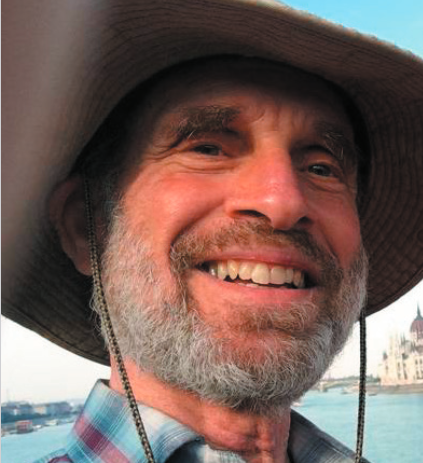 Andy Schmookler’s Podcast Interviews
 The American Crisis, and a Secular Understanding of the Battle Between Good and Evil
 None So Blind – Blog 2005-2011 on the rising threat to American Democracy
 How the Market Economy Itself Shapes Our Destiny
 The Sacred Space of Lovers
 The River and Its Channel: Bottom-Up (Flow) and Top-Down (Control) in Fostering the Good
 Ongoing Commentary to Illuminate the American Crisis
 What’s True About Meaning and Value
 Andy’s YouTube Channel
 The Fateful Step
 How the Ugliness of Civilized History is not Human Nature Writ Large
 Major Relevant Essays
 Healing the Wounds, Inflicted by the Reign of Power, that Drive Us to War
 Our Life-Serving Inborn Experiential Tendencies
 A Quest to Bridge America’s Moral Divide – 1999
 The Heirloom Project
 Knowing What’s Right to do Is Not a No-Brainer