


When “Maybe” Is Not Enough
My AI and I have a recurrent disagreement about how I should say things that I have come to believe—with some feeling of conviction—are true.
In many contexts, his concern to avoid a tone of certainty, where the truth has not been fully established, is appropriate. One’s language should acknowledge the possibility that we might be wrong.
But often, I am not speaking in such contexts. In pursuing my calling, the locutions that would please my AI—“maybe”—lose more in weakness than they gain in intellectual rectitude. The stakes are just too high to forfeit the power that comes from speaking with conviction.
Of course it’s true: one can always be wrong. But there’s a place for the prophetic voice, and the prophet says, “Thus saith the Lord,” not “Maybe the Lord would say…”
But I’ve been raised with enough of the intellectual code that drives my AI’s default reactions that I work full time to earn my feeling of conviction.
That means investigating energetically to discover what is true. That’s what I was brought up to do—think critically and rationally about the evidence to reach one’s tentative conclusions. That’s what I was educated to do. I was first trained to be a social scientist, an interpreter of contemporary events. It was only later—when I discovered the emergencies our world has placed us in—that I came to sound the alarm in a prophetic voice.
If a fire breaks out, one shouts “Fire!” and not, “These flames may indicate there’s a danger here.”
Conviction is different. When I KNOW there’s a fire, I am fully in that world with its flames. My life is oriented toward dealing with a reality that I’m not “maybe-ing” into uncertainty.
Life-and-death emergencies especially require that we stop being tentative and inhabit the picture—the Story—we have of the world. But the need to inhabit one’s Story is more general, even if not always so urgent. One’s Story tells us what the drama is in which we are living our lives. Without a Story, life can be lived, but its MEANING is not seen, not felt.
For our lives to be meaningful, for us to see what part we have to play, we humans need a Story.
It can be a simple Story—taking care of family, observing divinely sanctioned rituals, meeting responsibilities. And then there are those times when the stakes are higher, and we need a Story powerful enough to galvanize us to do what the situation requires.
But of course there is a terrible danger here. Human history is full of people galvanized by false Stories. The Protocols of the Elders of Zion was a fabricated fraud, which the Nazis employed en route to the Holocaust. People have killed while inhabiting Stories in which they believed they were doing God’s will.
So certainty can indeed be a problem, because Truth is important. And my AI’s default mode of acknowledging the “maybe not” in things can help protect against that problem. Science has demonstrated the enormous value of remaining uncertain—of treating our conclusions as provisional, always subject to revision in the light of new evidence.
The problem with the AI is that it is one-size-fits-all. Different purposes call for different ways of dealing with what we cannot know with certainty. Sometimes tentativeness is essential. Sometimes conviction is essential.
I’ve got a Story about Donald Trump as a Destroyer. Obviously, millions of Americans don’t accept that Story. But I believe I can make the case for it well enough that an impartial jury, weighing the evidence, would find Trump the Destroyer established beyond a reasonable doubt.
And if the survival of American democracy is on the line, what need is there for a voice full of academic pussy-footing? Sometimes conviction is essential. And the way to deal with the downside of certainty is to work like hell to get the Truth.
What we need, then, is a marriage of the True and the Good. We need the Truth so that the Story that galvanizes us points us in the right direction. And we need Conviction when the task is to mobilize people to fight for the Good.
BEYOND A REASONABLE DOUBT
Science may have no need for CERTAINTY. But the human world has other realms in which the Good requires that judgments be made, and in which the issue of Truth is also paramount.
Consider the courtroom. The prosecution must demonstrate the truth of its assertions “beyond a reasonable doubt.” It would be a grave wrong to convict contrary to the Truth. But it would also be a disservice to the world to fail to convict because some sliver of doubt remains.
And we don’t want the prosecutor arguing, “I suspect that this fellow committed the crime.” The prosecutor’s job is to make the strongest case the evidence warrants—and to speak like someone who believes in that case.
That gets close to the combination I aspire to in my own work. As an investigator, I follow the evidence wherever it leads. As a prosecutor, I try to make the strongest case the evidence allows. And when I believe that case establishes something of great importance beyond a reasonable doubt, the prophetic voice can declare the verdict with conviction.
The uncertainty belongs in the process of arriving at the verdict. It need not govern the voice with which the verdict is proclaimed.
And that brings me to the discovery that changed the course of my life—and that has made this question of “proclaiming with conviction” central to my life’s work.
More than half a century ago, I set out to understand why civilization has developed in such a destructive and tormented fashion—why the pages of history are so full of destruction and suffering. Then came the discovery that changed everything: I saw what I believed was the main part of the answer.
The idea hit me with such force and clarity that I immediately held it with a sense of conviction. But before I put that answer out into the world, I put it to every relevant test I could devise. I studied the question exhaustively, developing the idea in as many dimensions as such a big answer touched upon, to see whether it held together and whether it fit what was known in anthropology, archaeology, history, evolutionary biology, psychology, political science, and economics.
(By the time I presented the case in The Parable of the Tribes—published by the University of California Press in 1984—the bibliography alone ran 33 pages in small type.)
And that turned out to be only the foundation. Over the decades that followed, I continued testing and elaborating that picture, and discovered that several other major ideas could be derived from it. Gradually, the pieces fit together into a coherent, integrated, multi-dimensional whole that illuminated some of the major components of what has happened—and is still happening—in the world of the civilization-creating creature, our species.
I came to call that larger picture A Better Human Story.
But the point of a Story is not merely that its pieces fit together. A Story gives us a picture of the drama we are living in. It tells us what things mean, where we stand, and something about what part we are called upon to play.
So what picture of the human drama does A Better Human Story give us?
For one thing, it changes the meaning of the terrible record of human history. If The Parable of the Tribes is right, the destruction and suffering that fill those pages do not prove that this is simply what human beings are like. Much of that ugliness was generated by a system no one designed: societies caught in an overarching system without order, compelled to contend with one another for power, with the more destructive forms of power able to spread at the expense of the more benign.
That means that the ugly face history has so often displayed is not the true face of humankind. It is, rather, a distortion of human nature that has been selected by a systemic force inevitably unleashed when humankind broke out of the biologically evolved order in which our species had lived.
That matters. If the problem lies fundamentally in an incorrigibly destructive human nature, there may be little we can do but contain our worst impulses as best we can. But if a major source of the problem has been a systemic force that has driven civilization down destructive paths, a different possibility opens: we can change the system.
We can seek to transform the civilization that has shaped us rather than despairing of the creature that created it. And, knowing that we are better creatures than we have believed ourselves to be—better than our culture has taught us we are—we can recognize that we are capable of inhabiting a more whole civilization than we have previously imagined.
DISCERNING THE FORCE OF EVIL
That understanding of what had gone wrong in the human story also led me toward a way of understanding something our secular culture has largely ceased to take seriously: Evil.
I came to see Evil not as some supernatural power, nor as a property of particularly wicked people, but as a force that arises—inevitably—out of the disorder that—inevitably—accompanies the breakout into civilization. No Satan. No blaming the sinful creature. Rather, a systemic force operating through the straightforward workings of cause and effect.
Over the past twenty years, I have developed two ways of demonstrating—by looking rationally at the evidence—the reality of this force. Each of these demonstrations reveals a force “we can see in the same way as we can see the wind in the swaying of the trees and the flapping of the clothes on the line.”
And what we can see is “a coherent force that consistently works to make the human world more broken.”
That way of “Discerning the Reality of a ‘Force of Evil’” [LINK] became another dimension of the developing A Better Human Story—and, in these times, an important one. For this understanding of the destructive force operating in the human world enabled me to see very early a rising threat to American democracy—a threat that too much of America dangerously failed to recognize in time.
My calling grew more focused. I had spent decades talking about the destructive force that had shaped the course of civilization. Now I saw a recognizable form of that force rising in my own country—a country that not long before had been called “the world’s indispensable nation.”
I saw a fire, and I cried “Fire!” Something of enormous value was being consumed. Raising the alarm about what was happening to America became my full-time work.
Again and again, I encountered the response: Don’t be alarmist. That’s too harsh. How could I awaken people to the danger, and mobilize them to meet it?
Surely the answer was not to speak more tentatively about something I saw with conviction. If conviction was part of what I had seen, conviction had to be part of the message.
Which brings me back to “Trump the Destroyer,” a phrase I invoked earlier to exemplify my commitment to delivering with conviction those verdicts that are well proven beyond any reasonable doubt. By the time Trump appeared, I had been watching and warning about this destructive force for years. I immediately wrote of Trump as a symptom of that rising force, as well as a most dangerous agent of it.
Saving the country required seeing beyond even so profoundly destructive a person as an isolated phenomenon. It required seeing Trump’s emergence as part of a systemic force rising like a wrecking ball to attack the structures through which America had accomplished something remarkable in the human story.
WHEN EVERYTHING IS AT STAKE
Which returns me to why human beings need a Story. A Story tells us what drama we are living in, what is at stake, and what part we are called upon to play.
The Story I have spent more than half a century developing tells me that humankind is engaged in a drama whose outcome could hardly matter more: whether we can transform the civilization that has so often been driven toward Brokenness into one in which humankind can thrive—or whether the destructive forces unleashed in civilization will ultimately bring about our self-destruction.
And within that great drama, Americans are living through another whose stakes are immediate: whether we will recognize and beat back the Fascist Force now attacking the structures through which America accomplished something remarkable—or whether that force will overpower us.
A Better Human Story is the case I have spent more than half a century assembling. I offer it now to the jury. Examine the evidence. Test the argument. Decide whether the Story makes sufficient sense of what we have seen—in the great sweep of civilization and in the crisis confronting America—to warrant a verdict beyond a reasonable doubt.
For that is what we need: not the false certainty of an untested Story, but the reasonable certainty of a Story that has earned our conviction. A Story true enough to show us the drama we are actually in, and therefore to enlist us wholeheartedly in playing our part in it.
When everything is at stake, we need the Truth as best we can know it. And when the evidence warrants the verdict, we need to inhabit that Truth with the passion, energy, and conviction required to help bring the human Story to a better outcome.
[end with links to the BHS]
 A Mind-Blowing Collaboration Between a Human and an AI
 My Op/Ed Messages
 Andy Schmookler’s Podcast Interviews
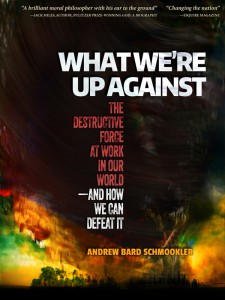 The American Crisis, and a Secular Understanding of the Battle Between Good and Evil
 None So Blind – Blog 2005-2011 on the rising threat to American Democracy
 How the Market Economy Itself Shapes Our Destiny
 The Sacred Space of Lovers
 The River and Its Channel: Bottom-Up (Flow) and Top-Down (Control) in Fostering the Good
 Ongoing Commentary to Illuminate the American Crisis
 What’s True About Meaning and Value
 Andy’s YouTube Channel
 The Fateful Step
 How the Ugliness of Civilized History is not Human Nature Writ Large
 Major Relevant Essays
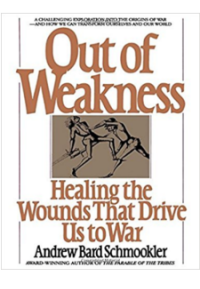 Healing the Wounds, Inflicted by the Reign of Power, that Drive Us to War
 Our Life-Serving Inborn Experiential Tendencies
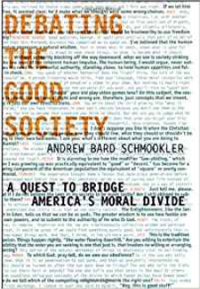 A Quest to Bridge America’s Moral Divide – 1999
 The Heirloom Project
 Knowing What’s Right to do Is Not a No-Brainer