


Much has been said lately about the importance of stories. We use them to make sense of our lives, to understand one another, and to give shape to our experience. In some way, we are all storytellers.
A story one tells about what happened at the supermarket is a story, and so is a newspaper account of an important event, and so is Tolstoy’s War and Peace.
Storytelling is an art form. But story is also something built into Reality itself.
- In Reality, things happen in time. Events unfold in sequence.
- In Reality, causes produce effects: what happens at one moment grows out of what happened before.
- And we sentient creatures experience these happenings as having meaning. Things matter to us. We hope for some outcomes and dread others, experience triumph and defeat, betrayal and reconciliation, danger and deliverance.
These are not inventions of storytellers. They are features of the world we inhabit.
So stories are partly natural. But they are also creations of the human mind. Although Reality supplies the happenings, it supplies vastly more than any storyteller could include.
Consider someone telling a friend about an unpleasant encounter at the supermarket. The storyteller doesn’t recount everything that morning: when the alarm went off, what the weather was like, which traffic lights were red.
Instead, the storyteller selects. Which elements of “what happened” make the experience a “story”?
The same principle operates on a grander scale in a great novel. Tolstoy wasn’t trying to tell us everything that happened to his principal characters – much less in all of Russia during the Napoleonic invasion. He had to choose what to show us, what to omit, what to emphasize, and how to arrange the pieces.
Stories are, in this way, like paintings. The world offers the painter almost limitless possible pictures. But the painter creates a particular picture by choosing what belongs inside the frame, what remains outside, and how the elements are arranged.
The artist – storyteller or painter – distills particulars from the unmanageable fullness of Reality. And the artist is not bound by Reality, but is free to create alternative realities — deliberately or through the misunderstandings and distortions to which human thinking and perception are prone.
Distillation goes further in a particular genre of story: the fable. Aesop’s tales reduce stories to their essentials. The fox who couldn’t reach the grapes appears only to decide therefore they must be sour. We know no more about the lion than that he discovered that even a humble mouse could be valuable.
And about the infamous couple who killed the goose that laid the golden eggs, we know only that the goose made them rich, and that their greed led them to kill it to get all the gold at once. The story is really about neither the particular couple nor their extraordinary goose. It’s about a pattern of human behavior. Grabbing for more can lead to getting less.
The fable is not primarily about something that happened. It is about something that happens.
The fable-teller strips from the story everything but what reveals a pattern that can recur in countless different circumstances. The fable doesn’t bother with what color clothes were worn by “the little boy who cried wolf.” What matters is that his repeatedly raising a false alarm about a wolf attacking his sheep results in people not believing him when a wolf finally does appear to destroy his flock.
The fable is a story constructed with extraordinary economy, like a little gem cut with precision to illuminate an underlying structure of human reality. It is a miniature narrative that represents a pattern the storyteller has recognized in Reality.
But the tradition of the fable has also given us one more step in the distillation process.
For centuries, editions of Aesop’s (and other) fables have often included a statement at the end explaining the lesson the story is supposed to teach: the “moral.” I’ve never been much of a fan of those morals. I think we should have to do the assignment ourselves, discerning the pattern that the story reveals. Boiled down to “the moral of the story,” the characters and the narrative disappear. No goose, no golden eggs, just the abstract principle that being greedy for more can leave you with less.
Each step in the distillation process imposes more order.
ALL THAT HAPPENS → STORY → FABLE → MORAL
With each step, as Judy Collins might put it, something is lost and something is gained.
What is lost, as the distillation progresses, is the experiential dimension. Our lives consist of experiences unfolding over time. And when we are told a story, we can enter imaginatively into the unfolding narrative, identifying with the characters and living vicariously through what happens to them. This is essential to what makes stories meaningful to us.
With the fable, the narrative has become so lean that we will never cry over the dead goose, or the slaughtered sheep, or the milk the milkmaid spilled—as we might in a well-told story.
Then, with the moral, we have dispensed with story and the experience it offers altogether.
But what is gained through this process of distillation is greater clarity about how the world is put together. What begins as chaotic, overwhelming reality gradually gets concentrated into what the distilling artist presents as insight.
 A Mind-Blowing Collaboration Between a Human and an AI
 My Op/Ed Messages
 Andy Schmookler’s Podcast Interviews
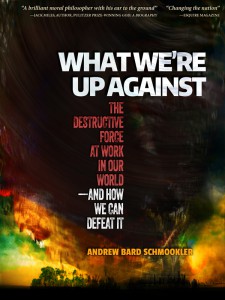 The American Crisis, and a Secular Understanding of the Battle Between Good and Evil
 None So Blind – Blog 2005-2011 on the rising threat to American Democracy
 How the Market Economy Itself Shapes Our Destiny
 The Sacred Space of Lovers
 The River and Its Channel: Bottom-Up (Flow) and Top-Down (Control) in Fostering the Good
 Ongoing Commentary to Illuminate the American Crisis
 What’s True About Meaning and Value
 Andy’s YouTube Channel
 The Fateful Step
 How the Ugliness of Civilized History is not Human Nature Writ Large
 Major Relevant Essays
 Healing the Wounds, Inflicted by the Reign of Power, that Drive Us to War
 Our Life-Serving Inborn Experiential Tendencies
 A Quest to Bridge America’s Moral Divide – 1999
 The Heirloom Project
 Knowing What’s Right to do Is Not a No-Brainer